Jeff Bezos Just Raised $12B for a Company With No Product. The Signal Is Bigger Than the Number.
Jeff Bezos just closed a $12B round at a $41B valuation for a company that has shipped nothing. The real signal isn't the number — it's where value is migrating: from bits to atoms.

FiscEdge Academy
Contributing Faculty & Practitioner
News Breakdown · FiscEdge Academy
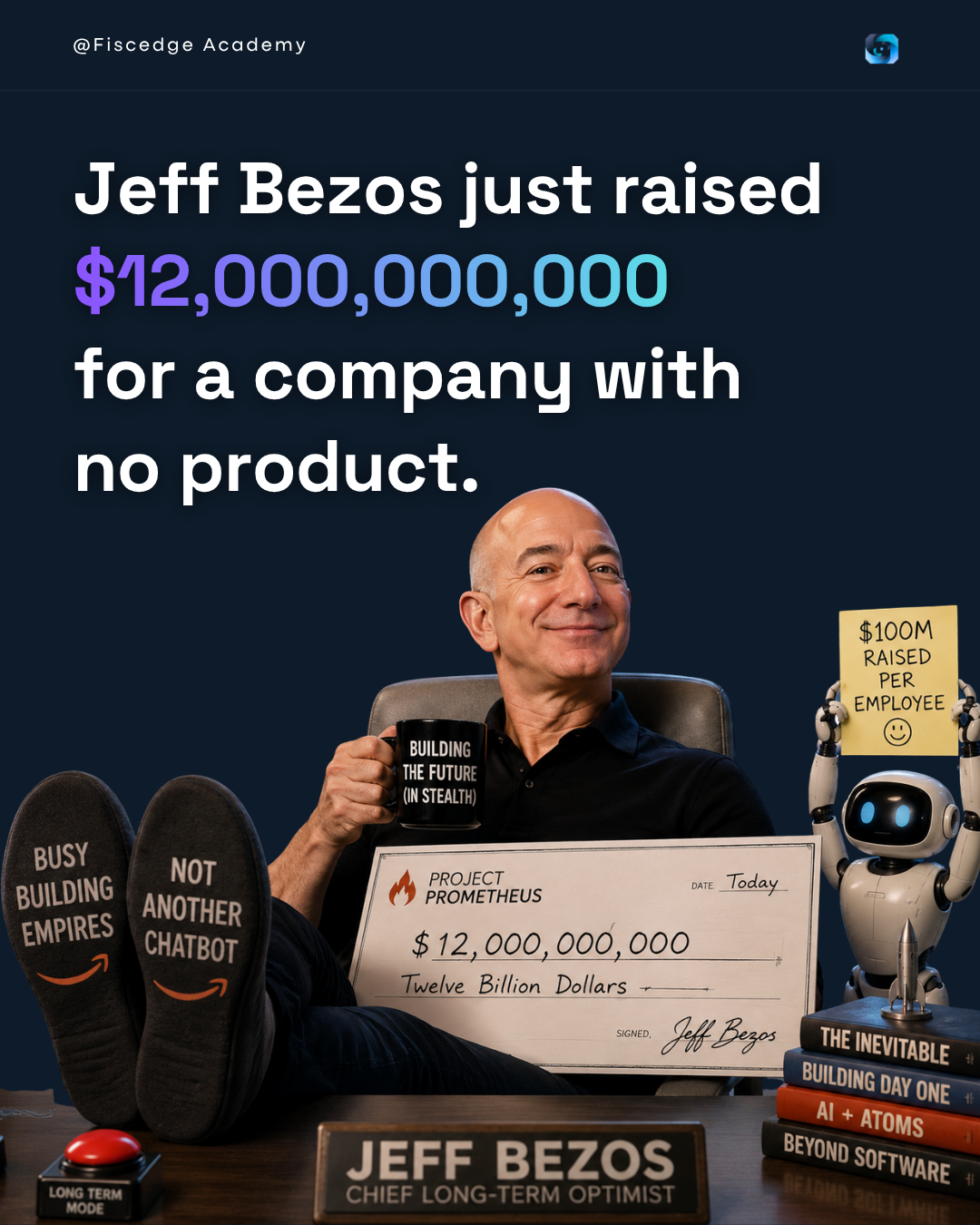
Jeff Bezos just closed one of the largest funding rounds in startup history for a company that has shipped nothing.
His AI startup, Prometheus, raised $12 billion at a $41 billion valuation — a Series B backed by JPMorgan, Goldman Sachs, BlackRock, DST Global, Arch Venture Partners, and Bezos himself. The company launched only in November 2025 with a $6.2 billion seed war chest. That's roughly $18 billion raised across two rounds for a team of about 150 people.
Do the math: that's around $120 million raised per employee. There is no public product. There is no pricing page. Most of the company is still in stealth.
So why are some of the most disciplined investors on earth writing checks this size?
What's actually happening
Forget "Bezos starts another company." That's the headline, not the signal.
Prometheus isn't building another chatbot. Bezos has been explicit that it has nothing to do with robotics either. The bet is something he calls an "artificial general engineer" — AI that designs and manufactures physical things. Think of it as a radically modern version of CAD: software that can help engineer a jet engine, a new material, or a drug compound, then compress the design-to-build loop into a fraction of the time.
The company runs out of San Francisco, London, and Zurich. It's co-led by Vik Bajaj, who previously co-founded Verily, Alphabet's life sciences arm. It has no corporate ties to Amazon or Blue Origin — though Bezos has hinted Blue Origin could be exactly the kind of customer Prometheus is built for.
In short: this is AI pointed at atoms, not pixels.
Why this should change how you think
Here's the part founders and operators need to internalize.
For the last decade, the default startup move was software: low capital, fast iteration, software margins. The problem is that everyone learned that playbook. Pure-software niches are crowded, and AI is making them more crowded by lowering the cost of building a SaaS to near zero.
When code becomes commodity, the moat moves somewhere else.
That somewhere is the physical world — where data is scarce, expertise is rare, the feedback loops are slow, and the capital required keeps casual competitors out. A messy, expensive, hard-to-copy problem is exactly what a serious investor wants right now. The difficulty is the defensibility.
That's why the smart money is quietly rotating from bits to atoms. Prometheus is the loudest example, but it's not alone — venture capital has been pouring into "physical AI" precisely because the real world creates moats that code alone can't.
The catch nobody puts on the slide
This is not a "go raise $12B" story. It's the opposite.
Bezos said it himself: this is a capital-intensive bet. Compute is expensive. The specialized training data doesn't exist on the open internet — there's no "internet of manufacturing data" to scrape — so it has to be built. There are reports of a separate effort to raise as much as $100 billion for an affiliated fund to buy legacy industrial companies, just to generate the data the AI needs.
Translation: the physical-AI moat is real, but the entry ticket is brutal. This is a game for people who can fund a decade of losses before a dollar of revenue.
So the lesson for an early-stage founder isn't "copy Prometheus." It's this: the value is migrating toward problems that are hard, slow, and physical. You probably can't out-capital Bezos. But you can ask a sharper question — where in my industry is the defensible work the software crowd is ignoring because it's too messy?
That's where the next ten years of opportunity is hiding.
If you remember one thing
When building software gets easy, building software stops being a moat. The advantage moves to the problems money and code can't shortcut.
This is the kind of framework we teach across FiscEdge's startup strategy course and AI for entrepreneurs tracks. For the other big story markets just priced, read how Elon Musk became the first trillionaire — and what it really signals — or browse the full blog. Follow @fiscedge for daily Business & AI breakdowns.
Topics & Categorization:
How interesting did you find this article?