Etched Raises $700M at a $21B Valuation. Its Lead Investor Is Also Its First Customer.
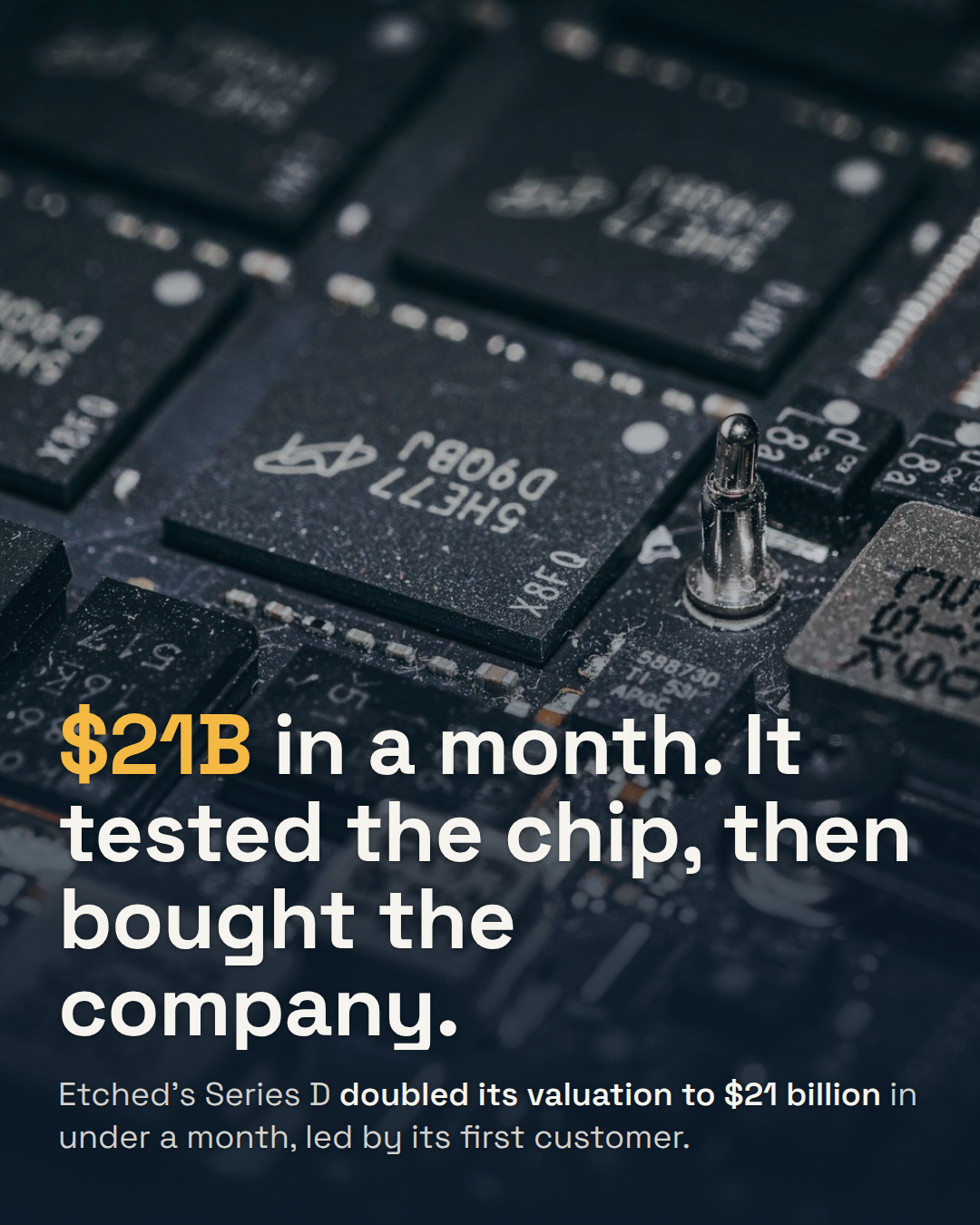
AI chip startup Etched raised $700M at a $21B valuation, doubling in under a month, after lead investor Jane Street tested the hardware, bought a rack, then wrote the check.

Fiscedge Academy
Contributing Faculty & Practitioner
News Breakdown · FiscEdge Academy
Etched, the AI inference chip startup taking on Nvidia, closed a $700 million Series D on August 18 at a $21 billion valuation, led by Jane Street. That is roughly double the $10.3 billion the company was worth after its Series C just twenty-six days earlier, on July 23, and more than four times the $5 billion it carried in December. The round also drew Kleiner Perkins, Sequoia Capital, Andreessen Horowitz, Peter Thiel, Tiger Global, Bain Capital Ventures, Neo, Stripes, Primary, Positive Sum, Diffusion, Argo and Blackstone.
The number is the least interesting part. What makes this round unusual, and worth studying if you sell anything to enterprise buyers, is who wrote the lead check: the company's own first customer.
The customer led the round
Jane Street, the quantitative trading firm, didn't take Etched's word for its hardware. It stress-tested the chips against its own most demanding trading workloads, bought a rack, deployed Etched's first shipped inference cluster into its own data center last month, and only then led the Series D. That sequence, test, buy, deploy, invest, is a due-diligence process most hardware startups can only dream of: a customer that put its own production infrastructure on the line before it put money in.
What Etched actually sells
Etched builds what it calls "frontier inference clusters": a low-voltage prefill chip paired with new memory and interconnect technology built specifically for the decode stage of AI inference. The company pivoted from its original plan, chips hard-wired to a single model architecture, into systems flexible enough to run any frontier model. That pivot is what turned Etched from a niche bet into a credible line item against Nvidia, and the company is reportedly recruiting engineers directly out of Nvidia's own hardware teams to build it out.
Why the curve matters more than the number
$5 billion in December. $10.3 billion on July 23. $21 billion on August 18. That is not a startup raising every twelve to eighteen months on a growth story; that is a startup raising every few weeks because demand for inference compute keeps outrunning the previous forecast, the same dynamic behind Nvidia lining up $500 billion in financing commitments and CoreWeave's backlog hitting $104 billion this month alone. Inference, not training, is where the AI infrastructure money is racing to right now.
What this changes for founders and operators
- A reference customer beats a reference logo. Jane Street's endorsement carries weight precisely because it came with a production deployment and its own capital, not a case study PDF. If you sell infrastructure or dev tools, one customer willing to co-invest is worth more than ten willing to tweet about you.
- Compute costs are still moving, not settling. If your unit economics assume today's inference pricing holds steady, model a faster hardware refresh cycle into your cost curve. New entrants at this valuation velocity mean pricing and performance both shift under you.
- Speed of raise is now a signal investors read differently. A 26-day gap between rounds used to look like distress. In this cycle, it reads as scarcity: the syndicate believed the next round would only get more expensive if it waited.
- "Nvidia alternative" is now a fundable category, not a vanity claim. If your roadmap depends on GPU availability or pricing, start tracking who else is shipping racks, not just who's raising rounds.
If you remember one thing
Etched didn't double its valuation in a month because of a pitch deck. It doubled because its most demanding customer tested the product with its own money on the line, bought it, deployed it, and then wrote the biggest check in the round. If you're building anything infrastructure-adjacent, that's the proof point to chase: not a logo, a customer willing to invest.
We break down how to read a funding round and a valuation curve like this one in FiscEdge's financial modeling course, and how infrastructure economics feed into your own numbers in startup strategy. For the fundamentals behind reading a cap table and margins, see what are unit economics on the blog. For more on the AI infrastructure financing wave, read our breakdown on Nvidia's $500 billion financing push. Browse the full blog for more breakdowns like this. Follow @fiscedge for daily Business & AI analysis.
Topics & Categorization:
How interesting did you find this article?