Global VC Just Hit a Record $510B in Six Months. 43% Went to Two Companies.
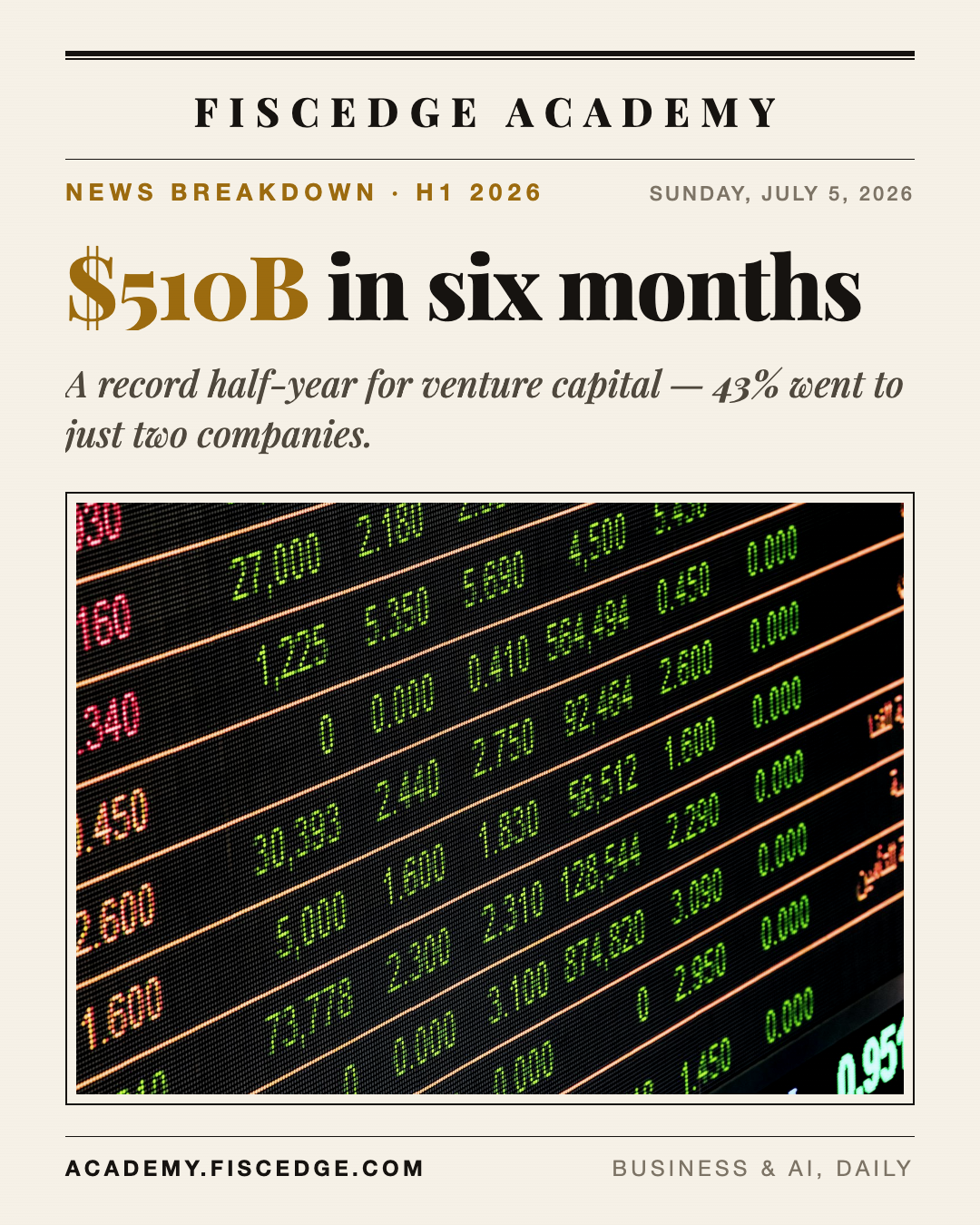
Venture funding posted its biggest half-year ever — $510B in H1 2026 — but OpenAI and Anthropic took 43% of it. Here is what a barbell market means if you are a founder raising anywhere below the mega-round layer.
Fiscedge Academy
Contributing Faculty & Practitioner
News Breakdown · FiscEdge Academy
Global venture funding just posted the biggest half-year in recorded history: $510 billion flowed into startups in the first six months of 2026, according to Crunchbase data. That's more than the $440 billion invested in all of 2025.
Investors deployed $305 billion in Q1 and another $205 billion in Q2 — the two largest quarters ever recorded, back to back.
If you stopped reading there, you'd think this is the easiest fundraising market of all time. It isn't. The number hiding inside the record is the one that should change how you operate.
The number inside the number
Of that $510 billion, $217 billion — 43% of everything — went to exactly two companies: OpenAI and Anthropic. Anthropic alone raised $65 billion, close to a third of all global venture funding for the period.
Zoom out one level and the picture stays the same: AI companies captured more than 70% of all startup capital in Q2, up from just under half a year earlier.
So the honest headline isn't "venture is booming." It's this: venture has split into two different markets. One market funds foundation models and AI infrastructure at nation-state scale. The other market — the one where you and every other founder actually operate — is fighting for what's left, and the bar there hasn't dropped. It has risen.
What this means if you're raising
Three practical consequences of a barbell market:
1. "AI" is no longer a differentiator — it's table stakes. When 70% of capital flows to AI, saying "we use AI" puts you in the most crowded room on earth. What investors are actually underwriting is the same thing as always: unit economics that work, a customer who pays, and a reason you win.
2. Concentration cuts both ways. Mega-rounds soak up headlines, but they also drag record amounts of capital into the ecosystem — IPO and M&A activity hit records this half too. Exits are back. For a fundable company at seed or Series A, the environment is better than the concentration stat suggests.
3. The story must survive the spreadsheet. In a market this narrative-driven, it's tempting to pitch the story and skip the model. Do the opposite. When 43% of capital goes to two names, everyone else gets diligenced harder, not softer. A 12–24 month financial model you actually understand is the cheapest credibility you can buy.
The deeper shift
Capital concentrating at the top of the AI stack tells you where the giants think value lives: compute, models, infrastructure. But history says the durable fortunes of a platform shift are usually built one layer up — by the companies that apply the new capability to boring, profitable problems.
The railroads minted a few tycoons. The economy that ran on the rails minted thousands.
You probably can't out-raise a foundation lab. You don't need to. The play for a founder in 2026 is to sit on top of collapsing AI costs and turn them into products with real margins — the exact opposite of the capital-intensive game being played above you. (This is the same logic behind why Bezos is pointing $12B at atoms instead of bits: when a layer commoditizes, the moat moves.)
If you remember one thing
$510 billion is not a signal that money is easy. It's a signal that money has picked a lane — and that the discipline required outside that lane just went up.
We teach founders how to read markets like this — and build businesses that survive them — in FiscEdge's startup strategy course and business fundamentals track. Browse the full blog for more breakdowns. Follow @fiscedge for daily Business & AI analysis.
Topics & Categorization:
How interesting did you find this article?