July 4, 1776: The Greatest Startup Ever Launched
56 founders, unlimited personal liability, a 1,337-word pitch and the largest incumbent on earth as competition. The real story of Independence Day — and what every founder can steal from it.
Fiscedge Academy
Contributing Faculty & Practitioner
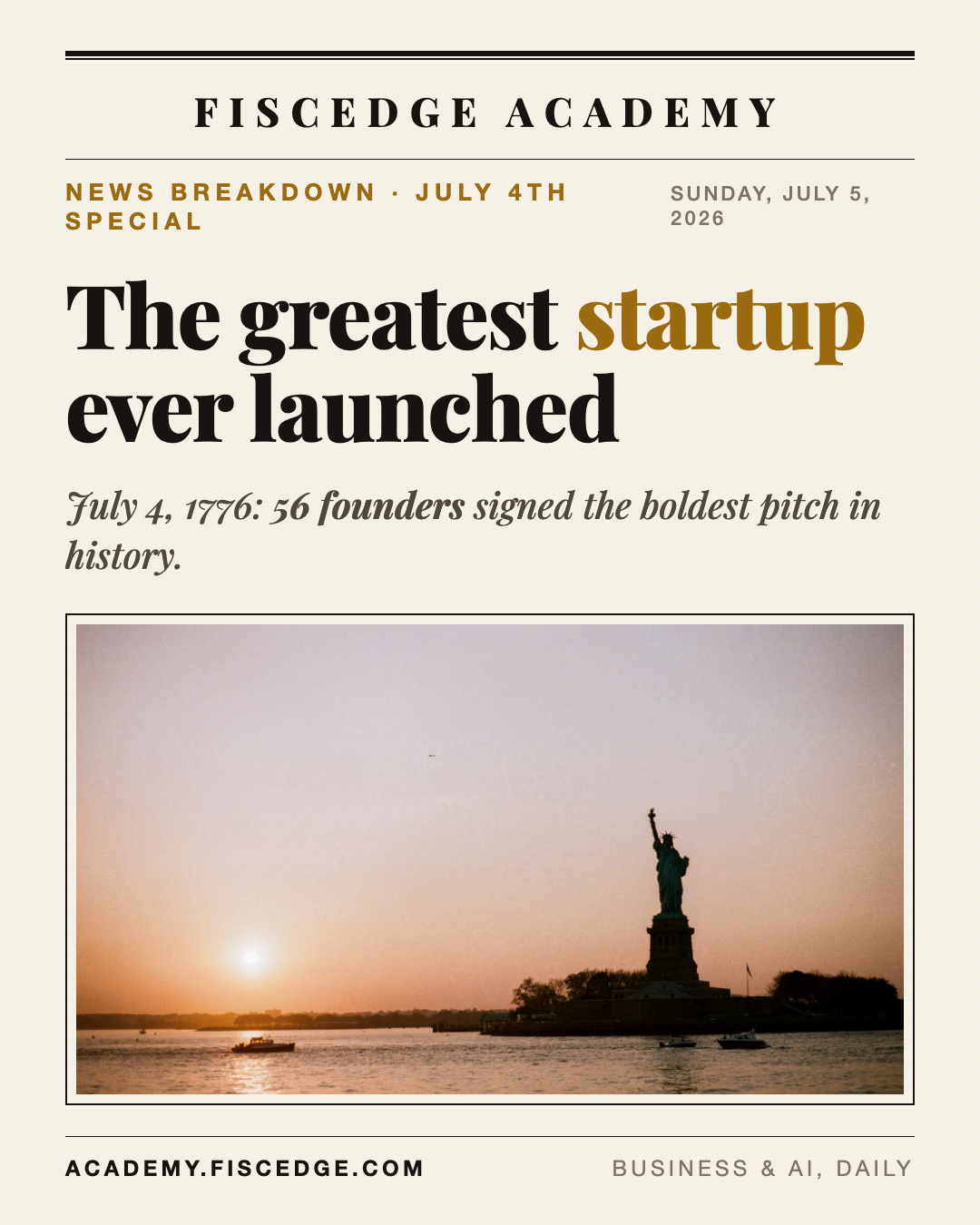
News Breakdown · FiscEdge Academy — July 4th Special
Two hundred and fifty years ago this summer, 56 men walked into a stuffy room in Philadelphia and signed what might be the boldest founding document in history.
Not a company charter. A country.
But strip away the powdered wigs and the parchment, and the story of July 4, 1776 reads like the greatest startup story ever told: a small team with no resources, taking on the largest incumbent on earth, armed mostly with a document and a conviction. If you build companies for a living, this holiday belongs to you more than you think.
The pitch deck was 1,337 words
The Declaration of Independence is structured exactly like a modern pitch. It opens with a vision statement ("all men are created equal… Life, Liberty and the pursuit of Happiness"). It follows with the problem: a brutal, itemized list of 27 grievances against King George III — the market pain, documented. And it closes with the ask and the commitment: "we mutually pledge to each other our Lives, our Fortunes and our sacred Honor."
Thomas Jefferson drafted it in about two weeks, in rented rooms on Market Street, at 33 years old. Benjamin Franklin and John Adams edited it — and Congress, like every committee since, cut roughly a quarter of his text. Jefferson reportedly hated the edits. Every founder who has watched investors redline a deck knows the feeling.
The risk was real — and personal
Signing wasn't symbolic. It was treason, punishable by death. The 56 signers were merchants, lawyers, and farmers — people with estates, businesses, and families — betting everything on an unproven venture. Legend has it Franklin quipped, "We must all hang together, or most assuredly we shall all hang separately." The line may be apocryphal; the stakes weren't.
That's the part modern founders should sit with. We call it "risk tolerance" when someone leaves a salary to start a company. These founders put unlimited personal liability on the table — the 18th-century version of signing a personal guarantee on the entire venture.
Anecdotes the textbooks skim over
The date is technically wrong. Congress actually voted for independence on July 2. John Adams wrote to his wife Abigail that July 2 would be "celebrated by succeeding generations as the great anniversary festival." He was off by two days — the text was adopted on the 4th, and the date on the document won. Most signatures weren't added until August 2. Even America shipped before the paperwork was done.
The founders' exit was cinematic. John Adams and Thomas Jefferson — co-founders turned rivals turned pen pals — both died on July 4, 1826, the 50th anniversary to the day. Adams' reported last words were "Thomas Jefferson survives." Jefferson had died hours earlier.
There's a note scrawled on the back. The reverse of the original Declaration reads, upside down: "Original Declaration of Independence dated 4th July 1776." Probably just a filing label from when it was rolled up for transport. Even the founding document of the United States needed a file name.
The first outside investor was France. Cash-strapped and outgunned, the American venture closed its "Series A" in 1778: the Treaty of Alliance brought French money, ships, and troops. Strategic investors with their own agenda — some things never change.
From 2.5 million users to the world's biggest market
At signing, the colonies held roughly 2.5 million people on a thin coastal strip. Today the United States is 340 million people and roughly a quarter of global GDP — the deepest, most liquid market on earth for anyone selling software, services, or ideas.
That compounding is the real lesson of the 4th. The founders didn't win because the odds were good. They won because they wrote down what they believed, signed it in ink, and committed everything to executing it — then built institutions that let strangers cooperate at scale. That's business fundamentals, 1776 edition.
And the model still runs: nearly half of Fortune 500 companies were founded by immigrants or their children — people who, like the signers, bet on the same idea that where you start doesn't decide where you finish. It's also why the US is the default target market in every startup strategy we teach, and why understanding it matters even if you're building from Milan or Berlin — something we covered from another angle in how founders raise in today's record VC market.
If you remember one thing
Every venture starts the same way: someone writes down a version of the future they can't yet prove, signs their name under it, and accepts the downside. The 4th of July is just the biggest example on record.
Happy Independence Day — now go write yours.
FiscEdge Academy teaches founders how to build for the world's biggest market — from business fundamentals to startup strategy. Browse the full blog for more breakdowns. Follow @fiscedge for daily Business & AI analysis.
Topics & Categorization:
How interesting did you find this article?