Microsoft's Cloud Business Grew 48%. It's Still Offering Buyouts to 60,000 People.
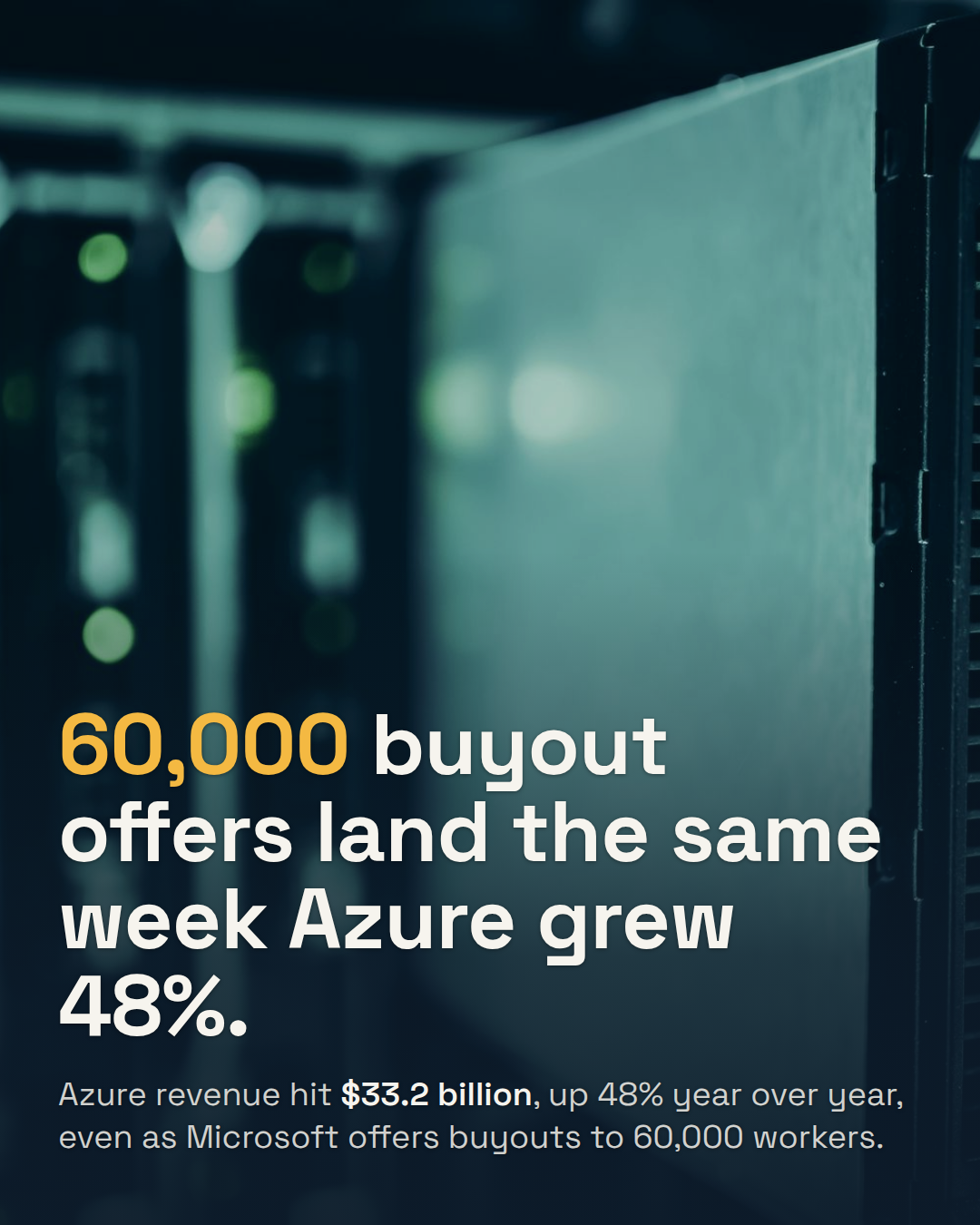
Microsoft's Azure revenue jumped 48% to $33.2 billion last quarter, and its contracted backlog hit $677 billion. The same week, it offered buyouts to a quarter of its workforce.

Fiscedge Academy
Contributing Faculty & Practitioner
News Breakdown · FiscEdge Academy
Microsoft posted one of the strongest cloud quarters in its history on October 28, and used the same ten-day window to tell a quarter of its workforce they can take a buyout.
The numbers: Microsoft's fiscal Q1 2027 revenue, for the quarter ended September 30, hit $92.3 billion, up 19% year over year, with operating income of $45.9 billion, up 21%. Azure, the cloud division everyone building on AI infrastructure watches most closely, grew 48% to $33.2 billion, up from $22.4 billion a year earlier and accelerating from 40% growth the prior quarter. Microsoft Cloud overall hit $63.9 billion, up 30%. The figure that matters most for anyone pricing compute two years out: commercial remaining performance obligation, Microsoft's contracted-but-not-yet-delivered backlog, jumped 73% to $677 billion. Two days earlier, on October 26, Microsoft told roughly 60,000 employees, about a quarter of its global workforce, at vice president level and below across the US, Canada, India and the UK, that they're eligible for a voluntary buyout, with decisions due in early December and departures set for December 31.
The backlog is the real headline
$677 billion in signed-but-undelivered contracts is the number founders building anything that touches AI infrastructure should sit with longer than the 48% growth figure. That backlog means enterprise and hyperscaler demand for Azure capacity is still running well ahead of what Microsoft can physically deliver, the same dynamic that has kept GPU and data center capacity tight, and expensive, across the industry for two years running. If you're planning compute costs, reserved-instance pricing, or a multi-cloud hedge for 2027 and 2028, a 73% jump in contracted-but-undelivered revenue is a cleaner signal than any analyst note: the supply crunch isn't closing, it's compounding.
Record growth and layoffs aren't a contradiction anymore
A 48% jump in your fastest-growing, highest-margin business line used to be the kind of quarter that insulated a company from headcount questions. Microsoft just proved otherwise: it posted the acceleration and opened buyout offers to 60,000 people in the same window. A company spokesperson said AI isn't driving the buyouts; most outlets covering the program described it explicitly as an AI-driven efficiency push, and this is the second such program in six months, following a smaller voluntary-retirement offer in the spring and a 4,800-person cut, about 2% of the global workforce, in July. Whichever framing is accurate, the practical signal for every operator is the one Netflix sent with its own layoffs-during-a-beat quarter weeks earlier: growth no longer buys headcount the way it used to. Boards are now comfortable asking why a team needs to stay this size even when the growth line is the best in company history.
The communication gap is the actual risk
The tension between "AI isn't driving this" and a press cycle unanimously framing it as an AI-driven efficiency push is worth studying on its own. When a company's internal line and the public narrative diverge this visibly, employees fill the gap themselves, usually with the less charitable version. If you're running any team through AI-driven restructuring, whether that means shipping an agent that absorbs a role or renegotiating headcount against a product roadmap, the lesson from this week is to pick one story and say it consistently, inside and outside the building. FiscEdge's Shadow AI and cognitive delegation masterclass covers exactly this governance question: how to talk about automation decisions without losing your team's trust in the process.
What this means if you're building on Azure, or against it
For founders whose stack sits on Azure, the 48% growth number is reassuring (the platform isn't slowing), and the $677 billion backlog is a planning input: expect continued capacity tightness and price multi-year commitments accordingly. For founders scaling their own teams, the more useful comparison is operating leverage. Microsoft just showed that revenue growth and headcount can move in opposite directions inside the same earnings cycle, and still be read by the market as discipline rather than distress. Building the roadmap that lets a smaller team do more without growing linearly is the same discipline we walk through in FiscEdge's Advanced AI Product Manager masterclass, and the underlying math is the same cost-to-build calculus every SaaS founder eventually has to run.
If you remember one thing
A record quarter no longer protects headcount, and the backlog number, not the growth number, is what tells you whether the demand behind it is real. Model both before you model your own hiring plan.
We cover the governance side of AI-driven headcount and automation decisions in FiscEdge's Shadow AI and cognitive delegation masterclass, and how to sequence a product roadmap against real infrastructure constraints in the Advanced AI Product Manager masterclass. For the cost math behind scaling a team without scaling headcount, see what it actually costs to build a SaaS product. Browse the full blog. Follow @fiscedge for daily Business & AI analysis.
Topics & Categorization:
How interesting did you find this article?