Microsoft Walked Away From Its Biggest UK AI Data Center. The Power Grid Said No Before Microsoft Did.
Microsoft canceled its anchor lease at Nscale's largest UK data center over grid delays stretching to the 2030s, days before Nscale's $35 billion IPO. Power, not chips, is now the binding constraint on AI infrastructure bets.

Fiscedge Academy
Contributing Faculty & Practitioner
News Breakdown · FiscEdge Academy
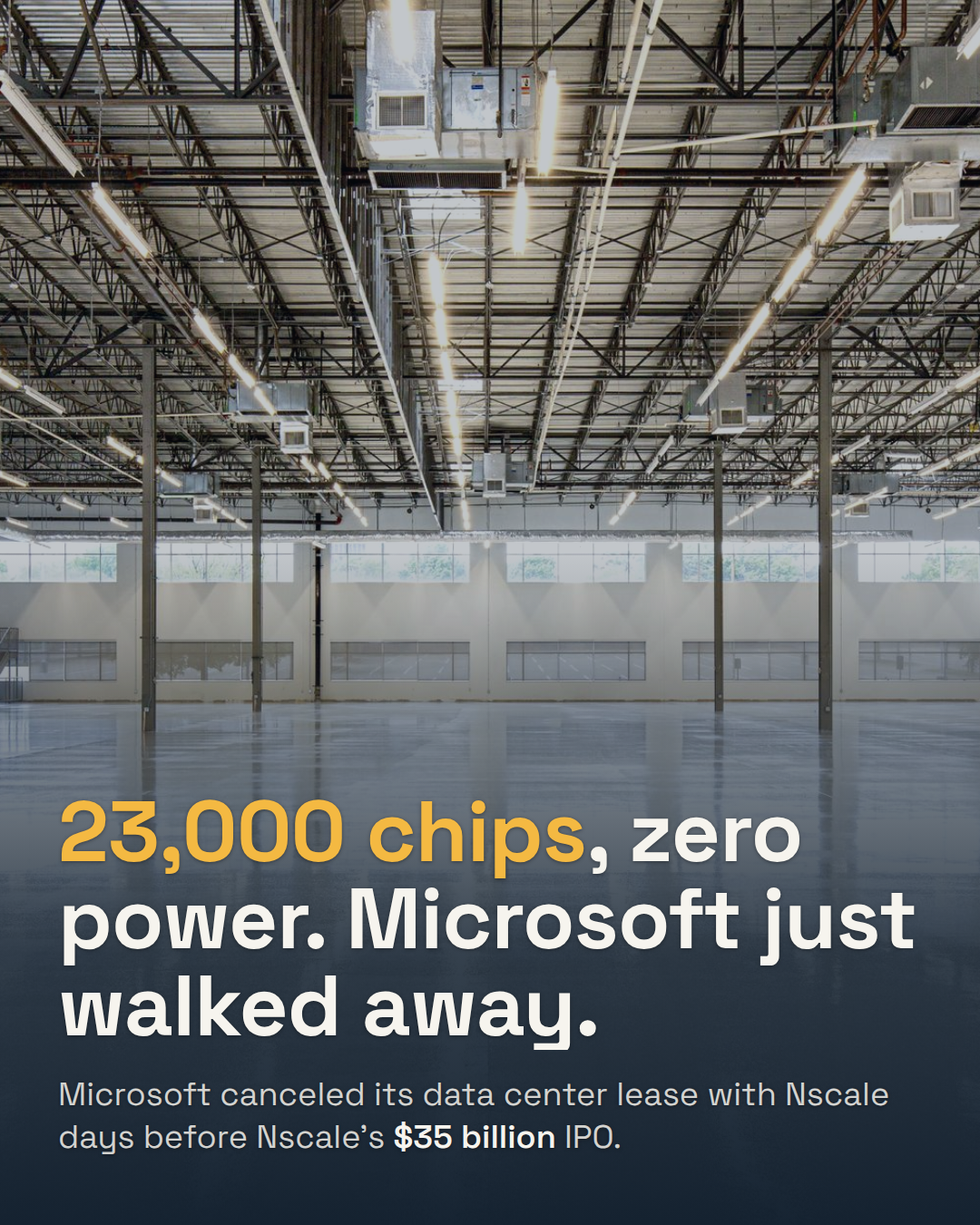
Microsoft just walked away from the UK's largest planned AI data center, weeks before the company that was building it tries to go public on the strength of exactly these kinds of contracts.
The deal: Microsoft had agreed to be the anchor tenant for a facility in Loughton, Essex, built by Nscale, renting capacity built around roughly 23,000 Nvidia AI chips. The site was part of a £2 billion (~$2.6 billion) UK buildout Nscale announced in January 2025, planned at 50 megawatts with room to scale to 90. The Telegraph reported Microsoft's exit on October 18; Bloomberg confirmed it. The stated reason isn't cost, chips, or softening AI demand. It's electricity. UK Power Networks told Nscale it can't guarantee grid power to the site until the early-to-mid 2030s, years later than the 2026-2027 timeline the project was built around.
Nscale says its relationship with Microsoft "remains strong and long-term," calls this a "London-wide grid issue" with no impact on its other contracts, and says it's exploring alternative power sources for the site.
The number that matters isn't 23,000 chips
It's the timing. Nscale is mid-process on a NYSE listing under the ticker NSCL, seeking a valuation around $35 billion and aiming to raise roughly $3 billion, with Goldman Sachs, JPMorgan and Morgan Stanley running the book. Its IPO filing discloses $103.4 billion in total contracted backlog, with Microsoft (about $43.8 billion through December 2033, across its full Nscale relationship) and Anthropic (up to $44.6 billion, for a 460-megawatt campus in West Virginia) together accounting for roughly 85% of it.
Backlog is the entire investment case for a company like Nscale: the pitch to IPO investors is "look how much revenue is already contracted." But contracted and built are different things. Of that $103.4 billion, only about $2.6 billion is tied to capacity that is actually live and operating today, and all 55 megawatts of that live capacity sits in Europe. Nscale's flagship Norway site, Glomfjord, is running about six months behind schedule, with 6.4 megawatts live against a planned 30, after cooling-system leaks, local permitting delays, construction slippage and a fire. That delay has already triggered contractual penalties owed to Microsoft and ByteDance, Bloomberg reports, though no dollar figure has surfaced.
Put the two stories together and the picture for anyone reading the prospectus is blunter than the backlog number suggests: Nscale's own largest contracted customer just canceled one of the projects behind that backlog, for a reason, grid connection, that also shows up at its flagship site. Nscale's first-half 2026 revenue was about $140.6 million, up a startling 1,252% year over year, next to a net loss that widened to roughly $1.02 billion. The company has already raised $3.36 billion in convertible notes ahead of the listing, with another $1 billion from Nvidia expected in November, both converting to equity at a discount once the IPO prices.
The signal under the headline
Every AI infrastructure story for the past two years has been about chips and capital: who can get Nvidia allocation, who can raise the check. This one is about neither. Microsoft didn't walk away because it ran out of money or lost interest in AI compute. It walked away because the local electricity grid told its landlord it wouldn't have power ready for most of a decade. That's now the real constraint on the AI buildout, and it doesn't show up on a cap table.
For founders, the read-through is concrete, not abstract. If your product roadmap, your unit economics, or your fundraising deck leans on "compute will keep getting cheaper and more available," that assumption now has a physical bottleneck with multi-year lead times attached to it, independent of how much capital anyone raises. Due diligence on an AI infrastructure vendor, whether you're renting GPUs, picking a model API, or underwriting a partnership, now has to include "does this provider's power actually exist," not just "do they have a signed contract." A contracted backlog number in an S-1 is a ceiling on revenue, not a floor; what converts it into cash is capacity that's actually energized, and that gap is where the risk lives.
If you remember one thing
A signed contract and a built data center are not the same asset. When you're evaluating any AI vendor, partner, or infrastructure bet, ask what fraction of their backlog is live today, not just booked, because that's the number that tells you what you can actually build on.
We teach how to stress-test a vendor's numbers before you build on them in FiscEdge's Advanced AI Product Manager masterclass, and how to think about dependency risk when AI vendors do real work inside your company in Shadow AI & Cognitive Delegation. For the economics behind a build decision like this, see what it actually costs to build a SaaS product. Browse the full blog. Follow @fiscedge for daily Business & AI analysis.
Topics & Categorization:
How interesting did you find this article?