Nvidia and 24 Other Companies Told Washington Not to Ban Open AI Models. OpenAI Didn't Sign.
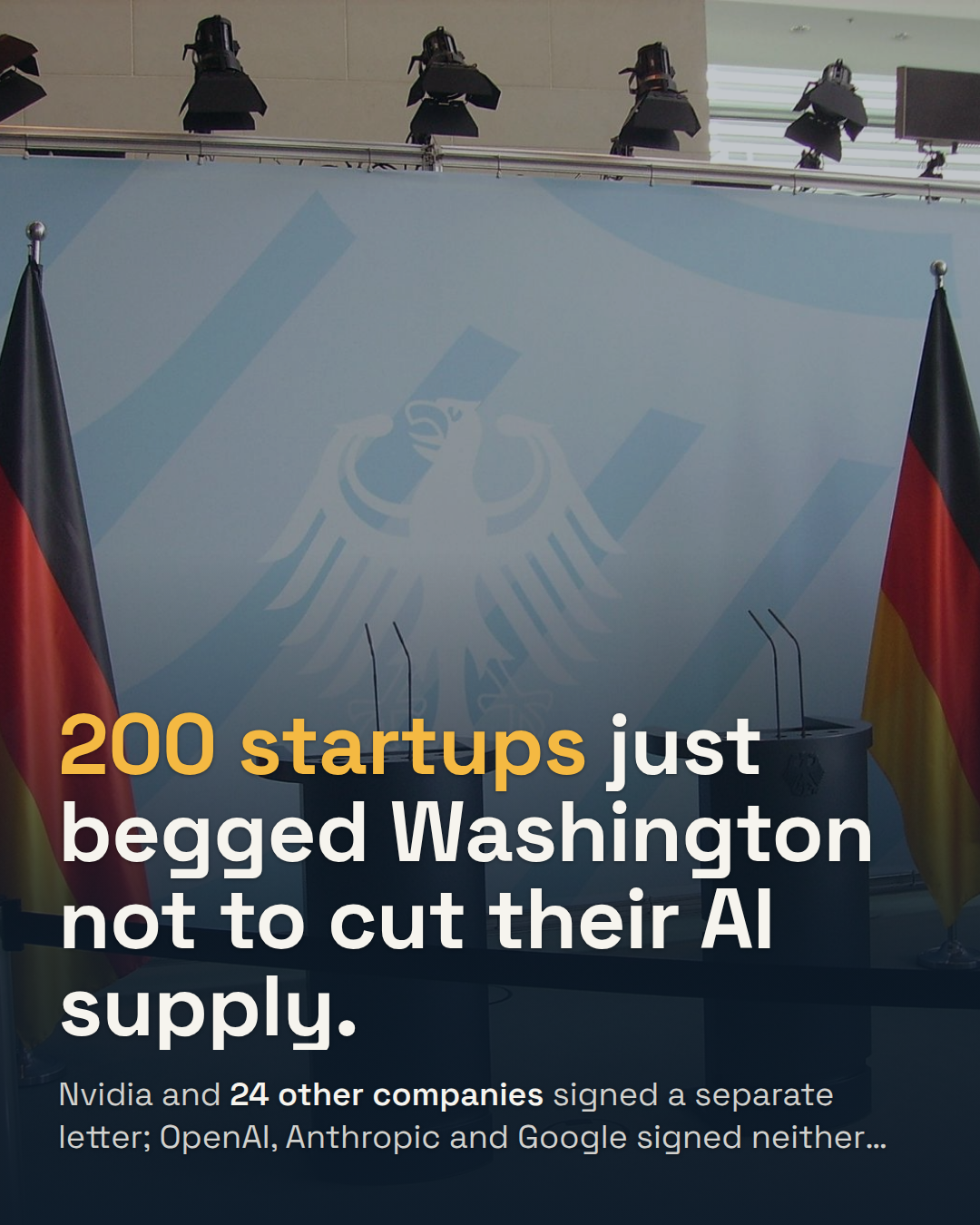
25 companies and nearly 200 startups sent Washington letters defending open-weight AI models on July 24. OpenAI, Anthropic and Google signed neither one.
Fiscedge Academy
Contributing Faculty & Practitioner
News Breakdown · FiscEdge Academy
On July 24, Nvidia and 24 other companies, including Microsoft, Meta, Dell, IBM, ServiceNow, CrowdStrike, Palantir, Hugging Face, Mistral, Andreessen Horowitz and Y Combinator, published a joint letter titled "Open Weights and American AI Leadership," urging Washington not to impose "premature restrictions" on open-weight AI models. Nvidia CEO Jensen Huang used his first-ever post on X to share it.
That letter is not the interesting number. Two days earlier, a newly formed group called the Little Tech Association, representing nearly 200 venture-backed startups, sent its own letter to President Trump, Commerce Secretary Howard Lutnick and White House science adviser Michael Kratsios, asking the administration not to impose a blanket ban on Chinese open-weight models like Moonshot AI's Kimi K3 and Alibaba's Qwen. The signal under the headline: two separate coalitions, 225 organizations combined, all telling Washington the same thing in the same week. And the three companies missing from both letters, OpenAI, Anthropic and Google, are the ones with the most to gain if open models get harder to use.
What Washington is actually weighing
The Trump administration is considering restrictions on Chinese AI systems following the scrutiny around Kimi K3, the Moonshot AI model that shipped frontier-level coding benchmarks at a third of the price of Claude and GPT-tier models, which we broke down here when it topped the Frontend Code Arena leaderboard. The concern in DC is IP theft and national security. The proposal on the table isn't narrow, according to the startups pushing back on it: it's broad enough to potentially cut off access to any Chinese-origin open-weight model, full stop, not just ones with a demonstrated security issue.
The split tells you who benefits from a ban
Look at who's absent from both letters. OpenAI, Anthropic and Google run closed, proprietary frontier models. A ban on cheap, capable open alternatives from China doesn't threaten their business, it removes their most credible competitive pressure on price. Everyone else on these letters, chipmakers, cloud infrastructure providers, dev tool companies and the VCs who fund early-stage AI startups, has a direct interest in founders continuing to have cheap, unrestricted access to open-weight models, whoever built them. Harry Godfrey, the Little Tech Association's executive director, put the founders' position plainly: the ask isn't zero restrictions, it's "the lightest-touch way that doesn't raise costs, limit access or inhibit American innovation while still addressing legitimate security concerns."
Why this is a build-stack risk, not a DC story
If you're a SaaS founder who fine-tuned a workflow on Kimi K3 or another open-weight Chinese model because it was a third of the price of the closed alternative, the letters this week are a direct signal that the ground under that decision could move. A blanket restriction wouldn't just be a headline, it would mean re-architecting around a more expensive closed-model vendor on someone else's timeline, not yours. That's the same single-vendor exposure we flag in FiscEdge's AI for entrepreneurs course: the cheapest model available today is not a permanent input, it's a policy-contingent one, and founders who treat model choice as a regulatory variable rather than a pure cost line are the ones who won't get caught flat-footed if this goes the wrong way.
What to actually do about it
Three things worth doing this week, not filing away:
- Know your exposure. If any part of your product runs on a Chinese open-weight model in production, write down what it would cost, in dollars and migration time, to swap to a US closed-model API on 30 days' notice. That number is your real risk, not a headline.
- Treat regulatory risk as a line item in your model. The same way you'd stress-test unit economics against a supplier price hike, run the scenario where your cheapest model option disappears entirely. This is exactly the kind of platform-dependency risk we cover in FiscEdge's startup strategy course.
- Don't wait for the ruling to diversify. A multi-model architecture that can swap providers isn't just a cost hedge anymore, it's now also a policy hedge, and it's cheaper to build that flexibility in now than to retrofit it under a deadline.
If you remember one thing
Twenty-five infrastructure companies and 200 startups just told Washington that cheap, open AI models are load-bearing for their businesses, and the three companies that stayed silent are the ones who'd benefit most if that access got cut off. If your product's economics depend on the cheapest model on the market staying legal to use, that's not a fact anymore, it's a bet, and it's worth pricing accordingly.
We teach founders how to build resilient, vendor-agnostic AI stacks in AI for entrepreneurs and how to stress-test platform and regulatory risk into your growth plan in startup strategy. For the cost-modeling habits behind decisions like these, see our breakdown of unit economics. Browse the full blog. Follow @fiscedge for daily Business & AI analysis.
Topics & Categorization:
How interesting did you find this article?