Nvidia Is in Talks to Buy an AI Lab It Already Owns 3% Of. The Structure Is the Real Story.
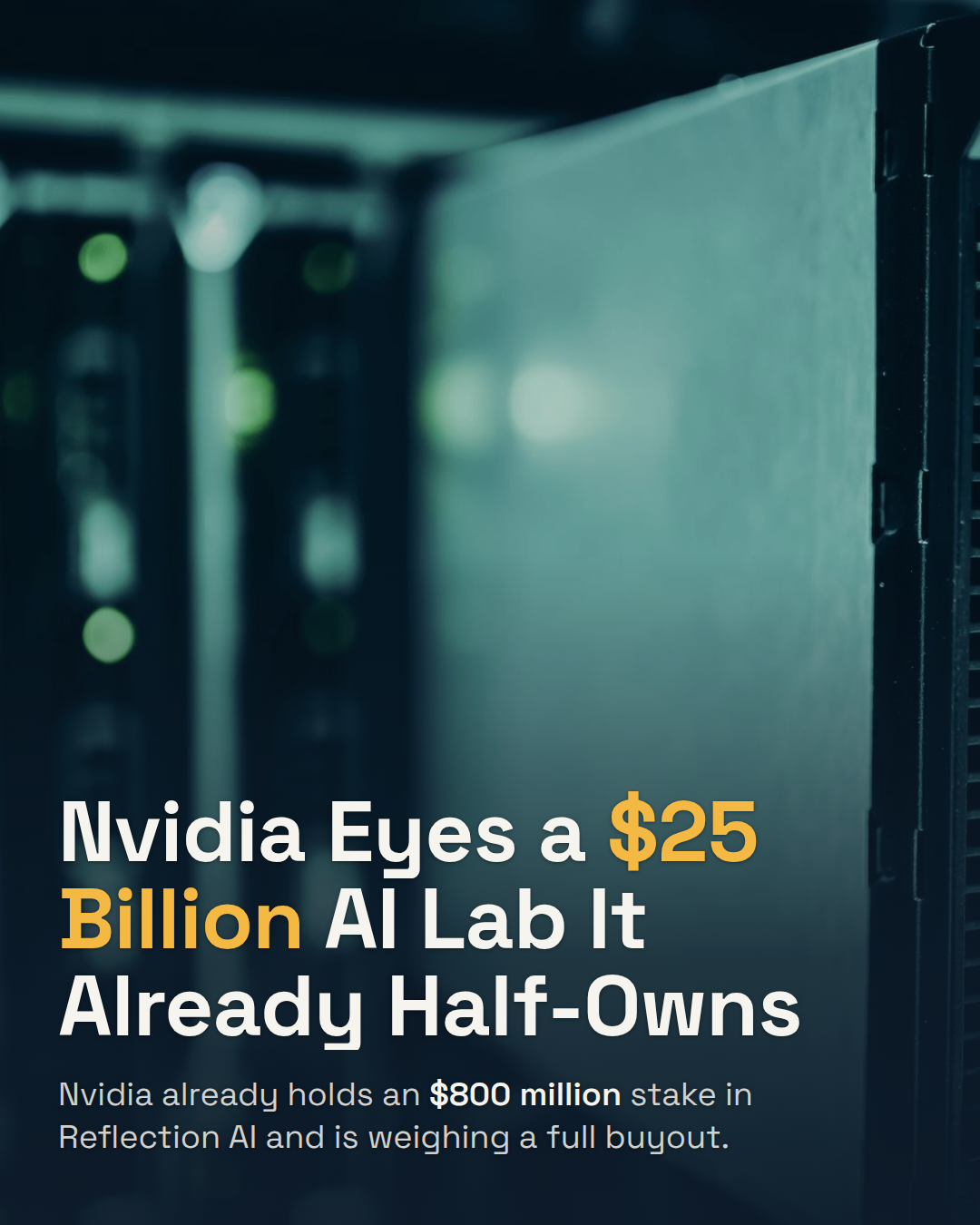
Nvidia is weighing a full acquisition, a bigger stake, or an acqui-hire of Reflection AI, last valued at $25 billion. The structure it picks reveals how it plans to dodge antitrust review.

Fiscedge Academy
Contributing Faculty & Practitioner
News Breakdown · FiscEdge Academy
Nvidia is in early talks to either acquire open-weight AI startup Reflection AI outright or deepen its existing stake, the Financial Times reported, with Reuters and Bloomberg both confirming the talks were underway. Reflection was last valued at $25 billion in a March funding round, a more than threefold jump from the $8 billion valuation it carried just five months earlier, in October 2025, when it raised $2 billion. Nvidia has already put roughly $800 million into the company. People close to the talks say an agreement could land within weeks, or collapse entirely.
The number everyone will fixate on is the $25 billion. It is the least useful one in the story. What matters is the shape of the deal Nvidia is reportedly weighing, because the shape is the tell.
Three structures, one motive: avoid the review
Reports describe Nvidia considering three paths: a full acquisition, a larger minority stake, or an "acqui-hire" in which Nvidia would hire Reflection's team and license its technology without buying the company outright. That third option exists for one reason. A dominant GPU supplier swallowing a well-funded AI lab whole is the kind of deal that draws a long antitrust review, and antitrust reviews are exactly what a company racing to ship product cannot afford to wait on. An acqui-hire gets Nvidia the talent and the technology on a timeline measured in weeks, not the year-plus a formal merger review could take.
This is the same maneuver Silicon Valley has run repeatedly over the past two years: Microsoft and Inflection, Amazon and Adept, Google and Character.AI. Buy the team and license the IP, skip the deal that regulators would have to approve. Founders negotiating an exit, especially in AI, should assume any acquirer with real antitrust exposure will propose this structure first and a straight acquisition only if the smaller option fails.
Why Nvidia wants a lab it already half-owns
Reflection builds open-weight large language models, five days before this report it shipped its first one, called Beam, positioned as a direct answer to the open-weight models coming out of Chinese labs like DeepSeek. Nvidia's business depends on every AI developer on earth needing more of its chips, which means Nvidia has a direct commercial interest in open-weight models staying competitive with closed ones from OpenAI and Anthropic: open models get run on infrastructure Nvidia sells into, not just infrastructure the model's own lab controls. Reflection also signed a compute deal worth more than $1 billion with cloud provider Nebius earlier this year, giving it a dedicated channel for Nvidia's newest GB300 chips regardless of who owns the lab.
That is the real signal under the headline. Nvidia is no longer just a supplier watching the model layer from the sidelines. It is reportedly moving to own a piece of it, less than six weeks after closing its $12.9 billion acquisition of Hugging Face on September 3. A company that sells the picks and shovels is starting to buy claims on the gold.
What this means if you build on top of Nvidia's stack
If your product sits anywhere in the Nvidia supply chain, as a reseller of GPU-backed compute, a tool built on an open-weight model, or a startup competing for the same enterprise AI budget, this deal (if it closes) changes who you are competing against. You would no longer be competing with Reflection as an independent lab trying to win customers on model quality alone. You would be competing with Reflection plus preferential access to Nvidia's chip roadmap, priority support, and a distribution advantage no unaffiliated lab can match. Model-layer startups raising right now should expect investors to ask, explicitly, whether a hyperscaler or chipmaker could absorb them the same way, and what happens to the cap table if an acqui-hire is the exit on the table instead of a clean sale.
The other lesson is about valuation math. Reflection tripled in value in under half a year without a product that had shipped a flagship model until last week. That is not a verdict on Reflection specifically, it is a reminder that in this market, compute commitments and chipmaker proximity move valuations faster than revenue does. Raise on that basis if you can get it, but underwrite your own plan on revenue, because the multiple that got you funded is not the multiple a public market, or a strategic acquirer's finance team, will apply later.
If you remember one thing
When a dominant supplier starts buying pieces of the companies that depend on it, structure the deal to avoid antitrust scrutiny (acqui-hire over acquisition) before structuring it to maximize price. If you are building anywhere near that supplier's stack, assume your next competitor might also be your supplier's half-owned subsidiary, and plan your moat accordingly.
We cover AI infrastructure strategy and how to build defensible product on top of someone else's platform in FiscEdge's Advanced AI Product Manager masterclass, and the risk side of depending on a single AI vendor in Shadow AI and cognitive delegation. For the fundamentals behind reading a valuation jump like this one, see what unit economics actually means. Browse the full blog. Follow @fiscedge for daily Business & AI analysis.
Topics & Categorization:
How interesting did you find this article?