OpenAI Will Cut Off Cursor's Models on November 12. Only 5% of Traffic Is at Stake.
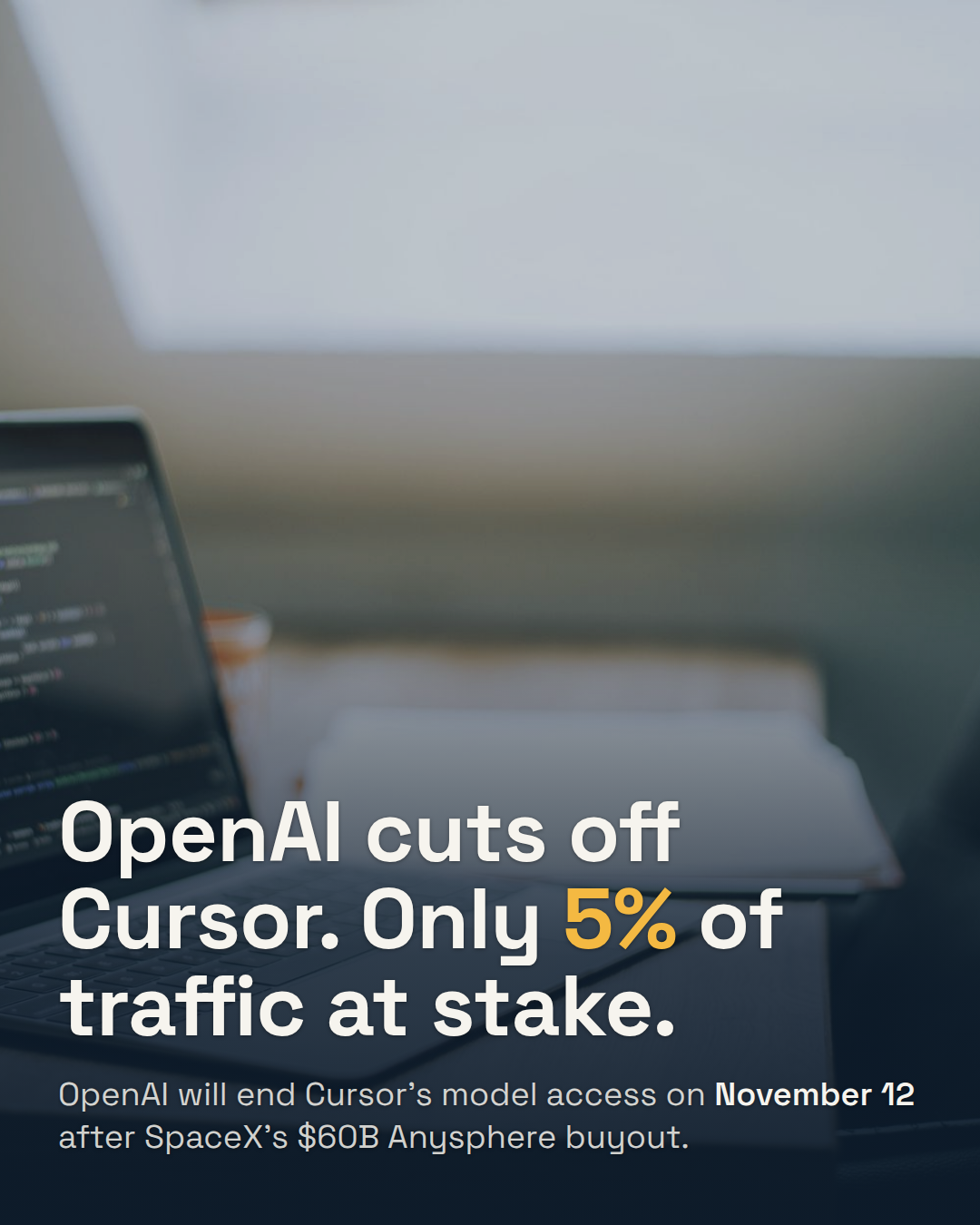
OpenAI is ending Cursor's direct model access on November 12, days after SpaceX closed its $60 billion Anysphere buyout. The real lesson is about who controls your AI supplier relationship.
Fiscedge Academy
Contributing Faculty & Practitioner
News Breakdown · FiscEdge Academy
OpenAI told Cursor it is cutting off direct access to its models on November 12, roughly two weeks after SpaceX closed its $60 billion all-stock acquisition of Cursor's parent company, Anysphere, on August 14. OpenAI says it cannot be confident SpaceX will keep using its technology within the terms of service, and it pointed directly to Elon Musk's track record of walking away from contracts with other companies.
Cursor CEO Michael Truell moved fast to shrink the story: OpenAI's models account for only about 5% of Cursor's user traffic today, he said, and Cursor's team is already talking to OpenAI to try to resolve it. Musk was less measured, calling OpenAI's leadership untrustworthy. Anthropic, sensing an opening, said within hours it would expand compute capacity to support higher Claude usage limits inside Cursor.
The 5% number is the least interesting part. The interesting part is that a $60 billion acquisition can trigger a supplier walking away from a customer relationship inside two weeks, over a change-of-control clause most founders never think to negotiate until it costs them something.
The signal under the headline
Cursor built a genuinely category-defining product on top of other people's models. That was the entire architecture: a slick interface and workflow layer routing requests to OpenAI, Anthropic, and Google. It is a smart way to ship fast and avoid the cost of training foundation models yourself. It is also, as this week showed, a dependency you do not fully control, because the terms under which a model provider keeps serving you are not just about usage or payment. They are about who owns you.
SpaceX buying Anysphere activated a contract clause that had nothing to do with Cursor's product, its usage patterns, or its bill. It was about who now controls the company, and whether OpenAI trusts that new owner. Traffic share, uptime, and payment history were irrelevant to the decision. This is the kind of risk that never shows up in a pitch deck's dependency slide, because most founders model "what if the API gets more expensive" and never model "what if my acquirer makes my supplier walk."
Why this matters if you build on top of AI APIs
If your SaaS product wraps one or more foundation models, three things from this week are worth acting on now, not after your own version of this happens:
- Read the change-of-control language in every model API contract you sign. Most standard enterprise AI agreements now include some version of a clause letting the provider terminate or renegotiate on an acquisition, a new controlling shareholder, or a competitive conflict. Know what triggers it before you take an acquisition offer, not after.
- Multi-model is now a resilience strategy, not just a cost-optimization one. Cursor's 5% figure is a defensible position specifically because the company already spread its dependency across three providers. A founder running 100% on one model API has no such cushion if that relationship sours for reasons that have nothing to do with the product.
- Model provider relationships are competitive weapons, not just infrastructure. Anthropic did not wait a day to offer Cursor more capacity. When your primary vendor becomes unstable, expect its competitors to show up in your inbox within hours, and treat that as leverage in your own renegotiation, not just a lifeline.
The bigger pattern
This is the second time in a year that a change in company ownership has scrambled an AI supply relationship rather than a change in the technology itself. As more AI-native companies get acquired by strategics with their own competitive interests, model providers are going to keep writing tighter change-of-control terms into their contracts, and founders building on top of any single API are going to keep discovering those terms exist only when they get triggered.
If you remember one thing
The risk in an AI API dependency is not just the bill or the rate limit, it is who is allowed to own you afterward. Read that clause before you need it, and build your product so that no single model provider walking away can take your company down with it.
We cover exactly this kind of vendor and dependency risk in FiscEdge's AI for entrepreneurs course, and how to architect a product so it survives a single vendor's decisions in building SaaS with AI. For more on the mechanics behind AI-assisted development, see our primer on what vibe coding actually means. We broke down the original $60 billion SpaceX acquisition of Cursor when it closed. Browse the full FiscEdge blog for more breakdowns like this one. Follow @fiscedge for daily Business & AI analysis.
Topics & Categorization:
How interesting did you find this article?