The Pentagon Is in Talks to Lend Fluidstack $5 Billion. That Would Be Its Biggest Loan Ever.
The Pentagon is in talks to lend AI cloud startup Fluidstack $5 billion, the largest loan its infrastructure-financing office has ever made. Washington is becoming an AI venture lender.

Fiscedge Academy
Contributing Faculty & Practitioner
News Breakdown · FiscEdge Academy
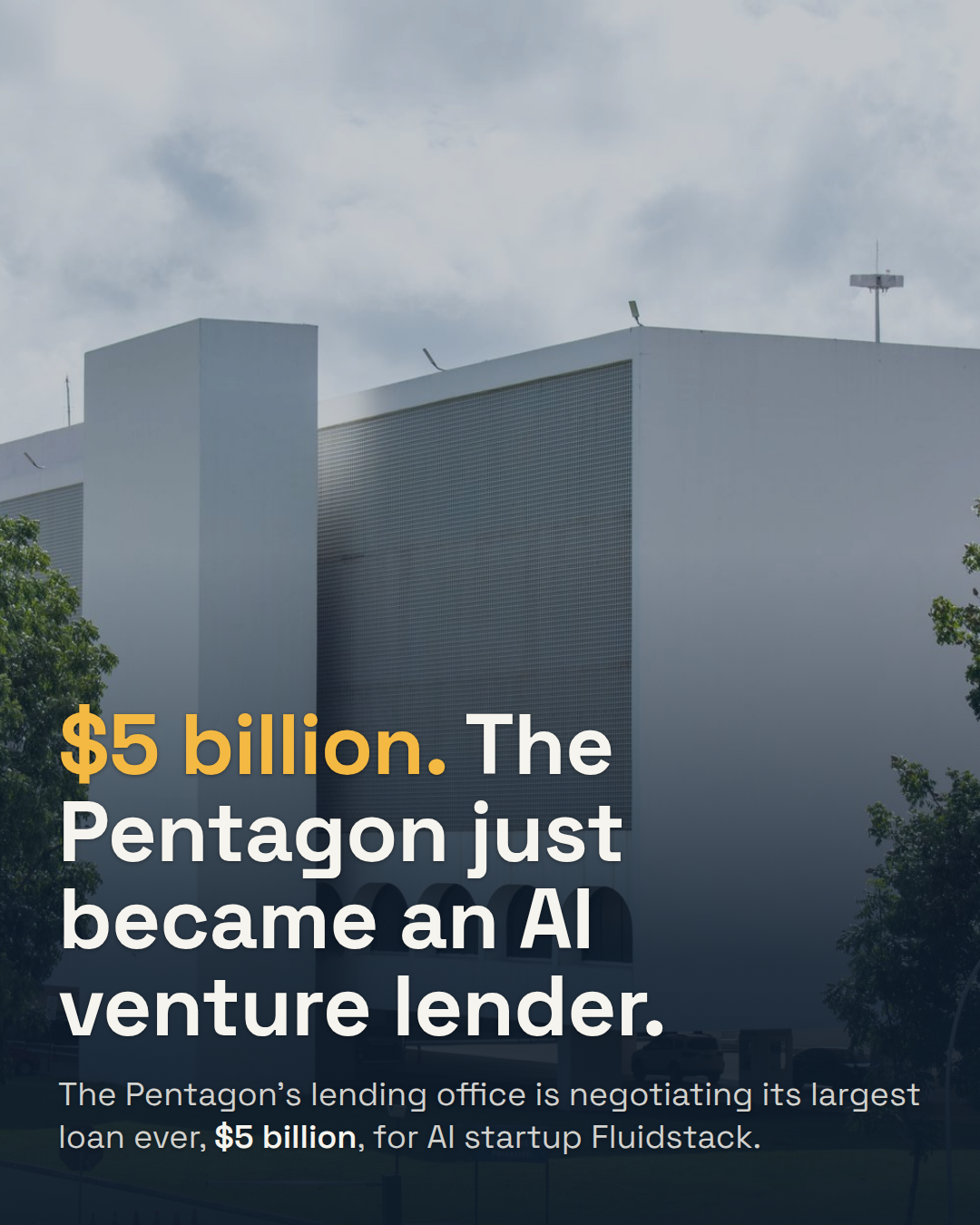
The Pentagon is in talks to lend $5 billion to Fluidstack, a five-year-old AI cloud startup, according to the Wall Street Journal. If it closes, it would be by far the largest loan the Pentagon's Office of Strategic Capital (OSC) has issued since the office was created, and it would come from an agency whose lending authority Congress just expanded from $984 million to more than $210 billion.
The money reportedly would not fund a shiny new data center directly. It is aimed at the less glamorous layer underneath: US manufacturing and supply-chain capacity for the components data centers actually need to get built. Fluidstack is working the application with Erebor Bank, a newly chartered bank catering to defense and deep-tech startups that Oculus founder Palmer Luckey opened in February.
The number is the least interesting part. The signal is that the US government is now underwriting the AI buildout the way it once underwrote semiconductor fabs and shipyards, and it picked a five-year-old private company, not Microsoft or Google, to make its first big bet.
From London seed round to Pentagon counterparty
Fluidstack started in 2019 as a small London outfit before relocating to the US and building out data centers in New York, Indiana, Louisiana and Texas. It raised a $3 million seed round, then a $200 million Series A in early 2025. From there the trajectory got steep: a raise at a $7 billion valuation brought in Situational Awareness, the AI-focused fund started by ex-OpenAI researcher Leopold Aschenbrenner, and by early September the company was negotiating a new $1 billion round, reportedly led by Jane Street, at an $18 billion valuation, up from $7.5 billion just months earlier.
The anchor behind that jump is a roughly $50 billion infrastructure deal with Anthropic to build dedicated data centers in Texas and New York, with Google acting as a backstop, guaranteeing payments if Fluidstack falls short on its obligations. By April, Fluidstack had $6.7 billion in contracted revenue effectively co-signed by Google. A federal loan is the next rung on the same ladder: private capital, then a hyperscaler guarantee, then the Pentagon.
Why a defense loan office is underwriting compute
OSC was built to backstop critical supply chains, and its budget jumping 213x in a matter of months tells you Washington now treats AI compute as one. The reported structure matters here: this isn't the Pentagon buying GPUs. It's financing the boring inputs (grid hardware, cooling systems, the manufacturing capacity behind them) that determine whether anyone's AI roadmap actually ships on schedule. Nothing is signed yet. WSJ's reporting notes the deal isn't finalized and no interest rate, maturity, collateral package or recourse structure has been disclosed. Treat the terms as a headline, not a term sheet, until a filing confirms them.
What this means if you build on top of the buildout
Most founders reading this don't compete with Fluidstack, but almost everyone building an AI product now depends on someone in this chain: a neocloud, a hyperscaler, a chip lease. Three things worth internalizing:
- Compute supply is becoming policy, not just markets. If the government starts co-financing data center supply chains, capacity constraints that looked like a 2026 problem could ease, or shift toward whoever the government picks as counterparties.
- The capital stack for AI infrastructure keeps stacking new layers on old ones. Equity, hyperscaler guarantees, and now sovereign lending, all on top of the same physical buildout. If you raise on the strength of "we run on X's infrastructure," know who is actually holding the risk underneath X.
- Government-backed suppliers can become surprisingly durable vendors. A neocloud with a Pentagon credit line and hyperscaler backstops is a different kind of counterparty risk than a startup burning venture debt. Underwriting matters when you're picking who to build on.
None of this changes unit economics for a SaaS company overnight. It does change how much you should trust that GPU capacity, and pricing, will still look the way it does today twelve months from now.
If you remember one thing
When a government lending office grows its authority 213x and its very first move is a multibillion-dollar loan to a five-year-old AI cloud startup, that's not a one-off headline, it's a new floor under AI infrastructure spending. Founders who build on top of that infrastructure should watch who's underwriting it as closely as they watch pricing.
We break down capital-raising mechanics like this one in FiscEdge's financial modeling course, and cover how to build durable products on shifting infrastructure in AI for entrepreneurs. For the debt-versus-equity math behind AI infrastructure bets, see today's earlier breakdown on Oracle's $664 billion backlog and $20 billion stock sale. More fundamentals in what are unit economics. Browse the full blog. Follow @fiscedge for daily Business & AI analysis.
Topics & Categorization:
How interesting did you find this article?