Tesla's Driverless Cybercab Launched Thursday. NHTSA Opened a Federal Audit Friday.
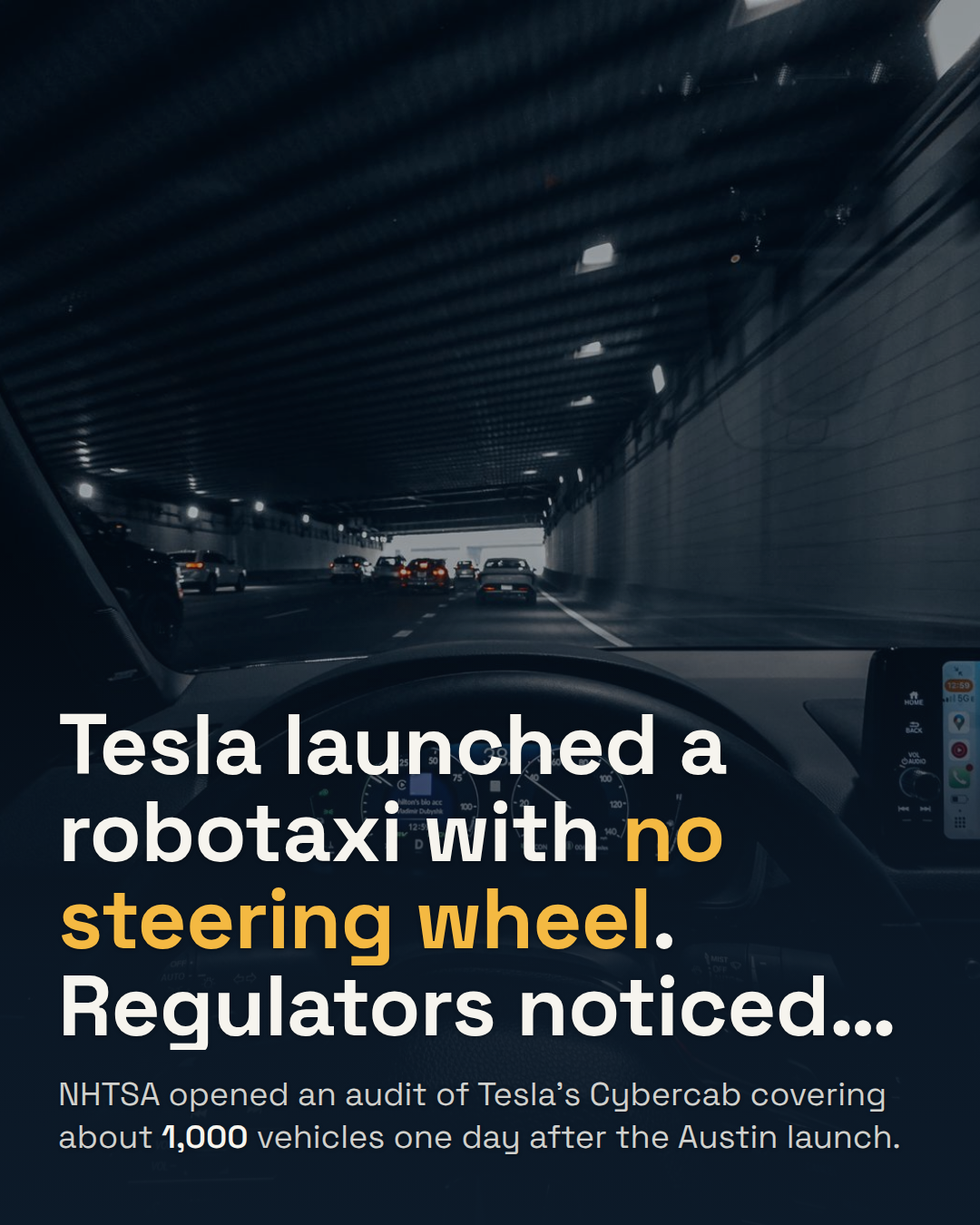
Tesla put driverless, wheel-free Cybercabs on Austin streets on September 3. NHTSA opened a federal audit within 24 hours, and Tesla stock erased its pre-launch gain the same day.
Fiscedge Academy
Contributing Faculty & Practitioner
News Breakdown · FiscEdge Academy
Tesla put its Cybercab into commercial service in Austin, Texas on Thursday, September 3, opening driverless rides with no steering wheel, pedals, or mirrors inside a geofenced zone through the Tesla Robotaxi app. The stock rose 5.4% that day on the news. By Friday it had given back the gain and more, closing down 6%, after the National Highway Traffic Safety Administration opened Audit Query AQ26002 into whether Tesla's self-certification of the vehicle actually holds up.
None of those numbers is the interesting one. The interesting fact is what NHTSA is actually questioning: not a crash, not a malfunction, but whether Tesla was right to decide, on its own, that federal safety rules written for cars with steering wheels simply don't apply to a car that doesn't have one. Here's the signal under the headline.
Self-certification is a bet, not a shortcut
Every new vehicle sold in the US has to meet Federal Motor Vehicle Safety Standards, and manufacturers are trusted to self-certify compliance rather than wait for a regulator's pre-approval. Tesla used that system to decide the Cybercab satisfies the rules by treating the standards that assume a driver, a wheel and pedals as inapplicable to a vehicle that ships without any of them. NHTSA's audit query, opened the day after the estimated 1,000-vehicle Cybercab fleet started carrying passengers, is a formal review of that judgment call: the agency wants the underlying technical data Tesla used to decide those standards didn't apply.
That's a materially different regulatory path than the one Amazon's Zoox took. Zoox spent six years pursuing a first-of-its-kind NHTSA exemption before it was allowed to charge fares in Las Vegas this August, capped at 2,500 vehicles. Tesla chose speed: certify itself, ship the product, and let the agency ask questions after the fact if it wants to. That's a legitimate strategy under US vehicle law. It's also one that puts the burden of proof on you retroactively, in public, right when investors are deciding whether to believe your growth story.
The stock move is the real data point
The market didn't wait for NHTSA's conclusion to price the risk. Tesla shares gained 5.4% into Thursday's launch event and lost 6% the next day once the update read as underwhelming and the audit landed in the same news cycle. Wells Fargo flagged operational complaints from early riders, including wrong routes, skipped destinations, and long waits. RBC Capital Markets said the launch left core questions on pricing, production timeline, and regulatory footing unanswered.
For a founder, that's the more transferable lesson than the audit itself. A regulatory filing can be spun in a press release. A same-day stock move of that size tells you what sophisticated investors actually believe about your risk, independent of your messaging. If your own fundraising story leans on a claim that hasn't been tested by a regulator, a customer at scale, or a competitor's lawyers, expect the market, or your next term sheet, to discount it the moment it's tested for real, not when you first make the claim.
What this changes for how you build
Know which regulatory path you're actually on. "Self-certify and move fast" and "get an explicit exemption first" are both legitimate strategies, but they carry opposite risk profiles: one is fast until it isn't, the other is slow but the ground doesn't move under you once you're operating. If you're building in a regulated category (fintech, health, anything with hardware near people), decide deliberately which one you're running instead of drifting into self-certification because it's the default.
An audit isn't a shutdown, but the market won't wait to find out. NHTSA's query ordered no recall and no service halt, and existing standards stay in force while the review runs. None of that stopped the stock from moving 6% in a day. Build your own runway assuming regulatory headline risk gets priced immediately, not after the process concludes months later, a discipline we walk through in startup strategy.
Ship the unanswered questions before someone else asks them publicly. Analysts flagged pricing, production timeline, and regulatory status as gaps in Tesla's own launch messaging. Those are exactly the questions any founder doing a public launch, a funding announcement, or a product reveal should have pre-answered, because the version of your story that goes viral is the one with the hole in it, not the one you wrote. That kind of narrative discipline around building and shipping AI-driven products is core to what we teach in AI for entrepreneurs.
If you remember one thing
Self-certifying that the rules don't apply to you is a real regulatory strategy, not a loophole, but it moves the burden of proof to after launch instead of before it. Know which side of that trade you're on before your own "we didn't need permission" moment lands on a regulator's desk, not after.
We cover regulatory strategy, fundraising narrative and go-to-market risk in FiscEdge's startup strategy course and AI for entrepreneurs. Browse the full blog for more news breakdowns. Follow @fiscedge for daily Business & AI analysis.
Topics & Categorization:
How interesting did you find this article?