Tesla's R&D Bill Jumped 69% in One Quarter. Operating Profit Fell 56% Anyway.
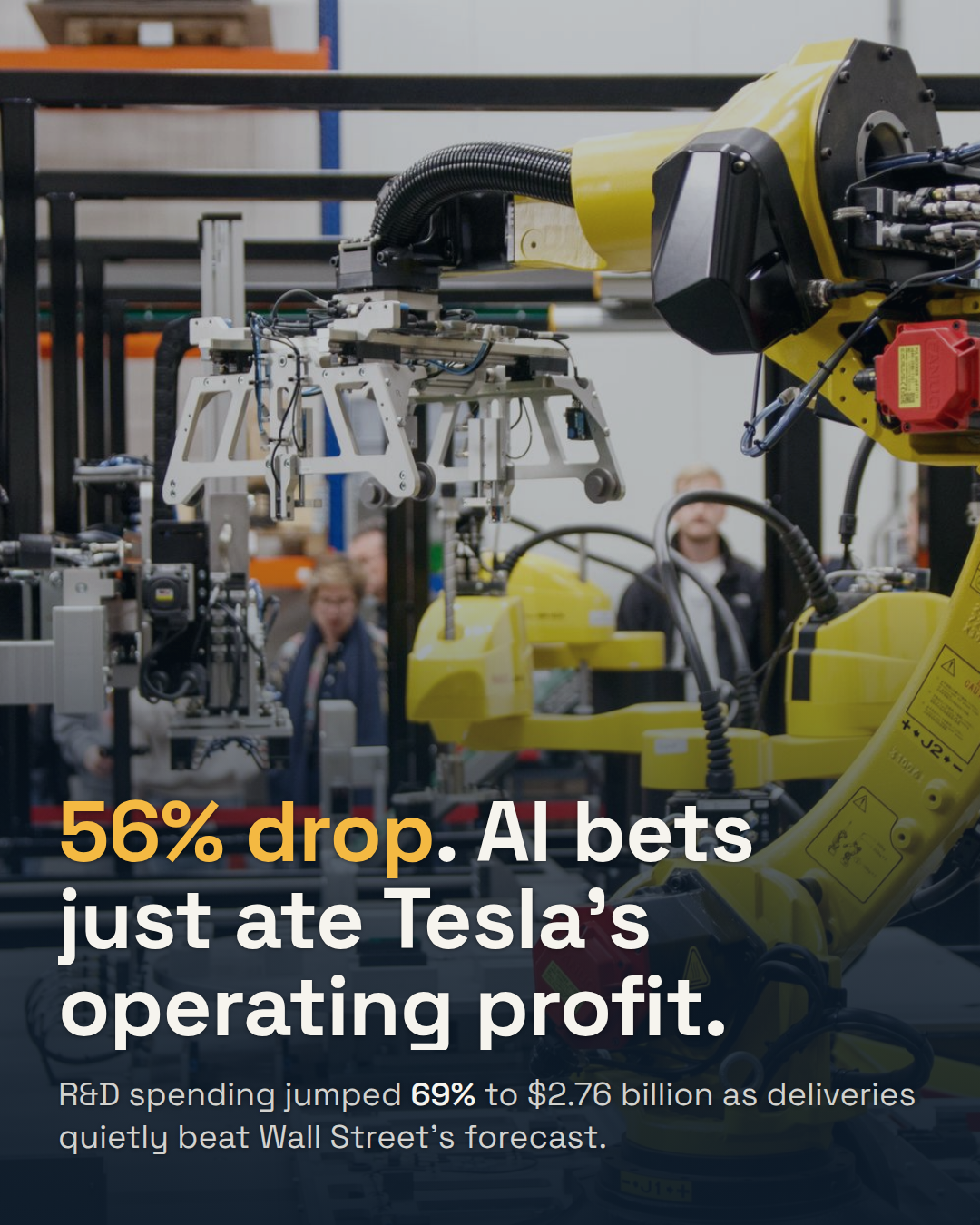
Tesla's Q3 R&D spend jumped 69% to $2.76 billion on AI and autonomy bets, and operating income fell 56% to $718 million. Deliveries still beat Wall Street.

Fiscedge Academy
Contributing Faculty & Practitioner
News Breakdown · FiscEdge Academy
Tesla's Q3 2026 earnings, released October 21, put a number on what an all-in AI bet costs a mature company: operating income fell 56% to $718 million, down from $1.62 billion a year earlier, even as revenue held flat at $28.05 billion. Operating margin collapsed to roughly 2.6%, from about 6% a year ago, on the same top line.
The trigger is in the SEC filing. Research and development spending jumped 69% year over year, to $2.76 billion from $1.63 billion, now 10% of revenue versus 6% a year earlier. Tesla attributes the jump to Optimus, in-house silicon development, battery technology and new vehicle programs, plus higher stock-based compensation. Non-GAAP EPS of $0.48 beat the $0.45 consensus but was down 4% from $0.50 a year ago; GAAP EPS came in at $0.22.
The number is the least interesting part
A 56% profit drop sounds like a company in trouble. It isn't, and that's the real story. Deliveries were 486,532 vehicles, down 2.1% year over year but well ahead of the 461,974 analysts expected. Automotive revenue fell 3%, but services and other revenue rose 33% to $4.6 billion, the fastest-growing line in the report. Free cash flow was $1.53 billion after $4.73 billion in quarterly capital spending.
So the core car business is stable-to-soft, the recurring-revenue layer (software, service, charging, insurance) is compounding, and the entire margin story comes down to one decision: Tesla chose to let R&D eat the P&L rather than slow it down. That's a capital allocation call a board made on purpose, not a cost blowing out of control.
The signal under the headline
Every operator building with AI right now faces a smaller version of this same trade-off: spend ahead of revenue on a platform bet (autonomy, robotics, a foundation model, an agent stack) and accept that the income statement will look worse before it looks better, or hold spending to protect this quarter's margin and risk falling behind on the thing that actually differentiates you in three years.
Tesla's bet is legible because the filing breaks it out. Most founders don't have that luxury internally; it's easy to let "AI R&D" become a catch-all line that nobody interrogates. The discipline worth copying isn't the size of the number. It's that Tesla can say exactly what the 69% increase bought: specific programs, each with its own shippable product (Optimus units, in-house chips, new vehicle lines), not an open-ended research budget.
What this changes for founders and operators
- Separate the bet from the business. If your AI spending can't be traced to a named initiative with a timeline, you're not making a capital allocation decision, you're drifting. Tesla's board can defend a 69% R&D jump because each dollar maps to Optimus, silicon or a battery program.
- Watch the recurring-revenue line, not just the headline margin. Tesla's 33% jump in services revenue is the part of this report that should get copied first: it's the layer that keeps growing while the core product is flat, exactly the SaaS logic of attach rate and net revenue retention applied to hardware.
- A beat-and-miss quarter is not a red flag by itself. Non-GAAP EPS beat, GAAP operating income cratered, deliveries beat, energy storage missed. Boards and investors who can't read a quarter with mixed signals in both directions will overreact to the wrong line.
If you remember one thing
A profit crash and a healthy business can show up in the same earnings release. What matters is whether the spending increase has a name, a product and a deadline attached to it, or whether it's just "AI" written on a blank check. If you can't trace this quarter's R&D line to something a customer will pay for within 12 to 18 months, you're not investing. You're hoping.
We teach the discipline behind this kind of capital allocation call in FiscEdge's Advanced AI Product Manager masterclass, and the governance side of unchecked AI spending in Shadow AI & Cognitive Delegation. For the unit-economics math behind separating a bet from the business, read what are unit economics. Browse the full blog for more breakdowns like this one. Follow @fiscedge for daily Business & AI analysis.
Topics & Categorization:
How interesting did you find this article?