USA Today's Publisher Sues OpenAI for $250 Million. The Real Claim Isn't Copyright.
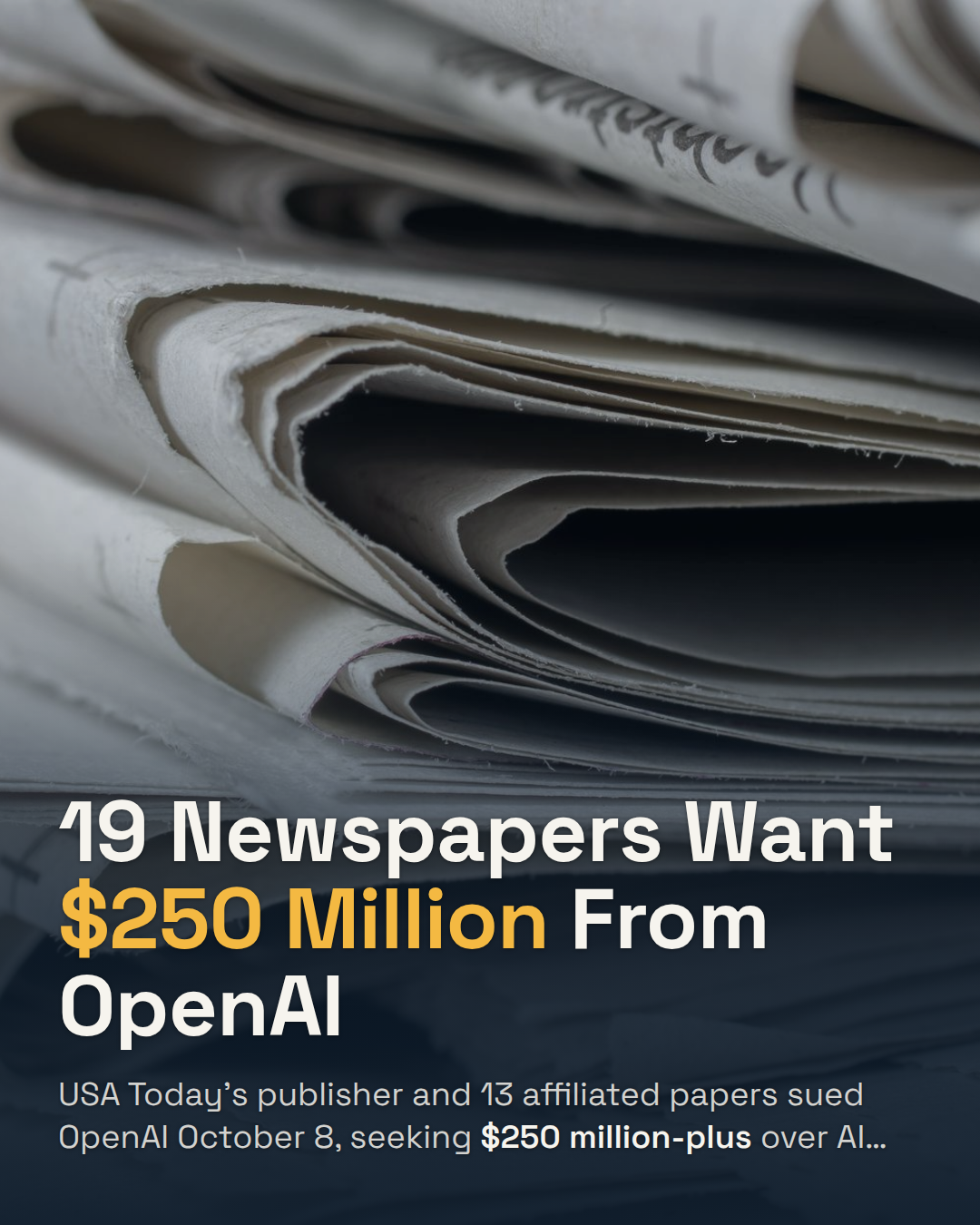
Gannett's USA Today network sued OpenAI on October 8, seeking over $250 million for training on 19 newspapers' articles. The DMCA metadata claim inside it is the one every AI builder should read.

Fiscedge Academy
Contributing Faculty & Practitioner
News Breakdown · FiscEdge Academy
Gannett's USA TODAY Co. and more than a dozen affiliated newspaper companies sued OpenAI on October 8 in federal court in Manhattan, seeking more than $250 million in damages. The complaint, filed in the Southern District of New York as USA Today Co. v. OpenAI Foundation, covers 19 newspapers and news sites, including the Courier Journal, the Detroit Free Press and The Arizona Republic, and alleges OpenAI trained its models on hundreds of thousands of their articles without a license.
The dollar figure is the least interesting part of this filing. Publishers have been suing AI labs since 2023, and $250 million barely registers against OpenAI's balance sheet. What makes this complaint different, and what every founder shipping an AI product should actually read it for, is the second claim buried under the copyright count.
The claim that isn't about copying
Alongside direct and vicarious copyright infringement under 17 U.S.C. §501, the publishers added a claim under the DMCA's Section 1202: that OpenAI intentionally stripped copyright-management information, author bylines, dates, publication names, from the articles before training on them. That claim doesn't require proving the output looks like the input. It only requires proving the metadata was removed. Fair use, the defense OpenAI has used in every prior case, is a copyright defense. It does nothing against a DMCA metadata-stripping claim, because that claim isn't about whether the copying was fair, it's about whether identifying information was deliberately deleted somewhere in the pipeline.
The suit also asks the court to relate it to the existing multidistrict litigation already running in the same SDNY courthouse, the same docket that absorbed The New York Times v. OpenAI and Microsoft. That's a deliberate move: instead of one more standalone case a defendant can out-litigate on resources, it becomes one more plaintiff inside a consolidated proceeding that is already shaping the industry's fair-use precedent.
Why the metadata claim is the one that scales
Every retrieval pipeline, every scraper, every dataset-cleaning script that strips HTML down to plain text before it hits a training run or a RAG index is, by default, deleting the exact fields this claim is built on: author, date, source, license tag. Most teams don't do this to hide anything. They do it because a cleaning script that keeps byline and attribution metadata attached to every chunk is more work than one that doesn't, and nobody budgets for that work until a lawsuit explains why they should have.
That is the actual exposure for a SaaS company bolting an AI feature onto a product, not the $250 million number. A DMCA §1202 claim attaches statutory damages per violation, separate from and on top of any copyright damages, and it doesn't require a court to decide whether your training data use was "fair." It requires a record of what your pipeline did to the files before you used them. If a founder can't produce that record, discovery fills in the worst version of the gap, the same way the market filled in the worst version of OpenAI's revenue gap two weeks ago.
What changes for teams shipping AI features now
Three things are now worth doing before a term sheet or an acquirer's diligence team asks, not after:
- Log what your ingestion pipeline strips. If you scrape, crawl, or clean third-party content before it touches a model or a vector store, know exactly which fields get dropped and keep that transformation auditable.
- Separate "licensed" from "scraped" in your data inventory. The labs now paying publishers for licensing deals (OpenAI, Microsoft and Google have all signed several since 2024) are the same ones being sued over the content they didn't license. Being able to show which sources are covered and which aren't is now a diligence question, not a legal nicety.
- Price the tail risk into any product built on third-party text. A consolidated MDL in the SDNY means a ruling on one plaintiff's claim increasingly sets the rule for all of them, including future ones. That is a faster path to precedent than any single suit moving alone.
If you remember one thing
A copyright fair-use defense protects you from one kind of claim. It does not protect you from a claim that your pipeline deleted the record of where your data came from, and that second claim is the one spreading fastest through SDNY's AI docket right now.
We cover the governance side of building with third-party and scraped data in FiscEdge's Shadow AI & Cognitive Delegation masterclass, and the product tradeoffs of shipping AI features responsibly in the Advanced AI Product Manager masterclass. Browse the full blog for more AI regulation breakdowns. Follow @fiscedge for daily Business & AI analysis.
Topics & Categorization:
How interesting did you find this article?